In a 16-week study, people who switched to placebo had worse hyperphagia than those who continued taking VYKAT XR
Total hyperphagia score change after 16 weeks
Lessening hyperphagia can take time, so it’s important to stick to a plan with VYKAT XR and your existing routines.
When Matthew was born, his parents were told that his anxiety around food would be so severe that he would eventually need to be institutionalized. His family was always on edge because any moment could be taken over by a food outburst. Since he began treatment with VYKAT XR, Matthew has more independence when it comes to food, loves to dance and sing, and brings a warmth to his family that they never thought possible.

“Matthew stopped talking about food as much. The questions started to come down from 1000 questions to maybe 200 questions.”
– Deahl, Matthew’s mom

Check out the handbook to better understand treatment with VYKAT XR
VYKAT XR was studied in a range of people living with PWS and hyperphagia
The effect of VYKAT XR on hyperphagia and food-related behaviors was measured using a caregiver survey
The impact of VYKAT XR on hyperphagia was studied in clinical trials where people were on treatment for 2.5 to 4.5 years. In the main clinical trial, half of the people in the trial were randomly selected to stop taking VYKAT XR and take placebo (a sugar pill) for 16 weeks. The other half continued taking VYKAT XR.
Before starting the main clinical trial, people took VYKAT XR for at least 2.5 years
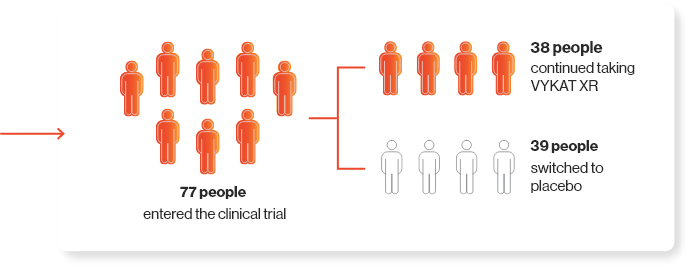
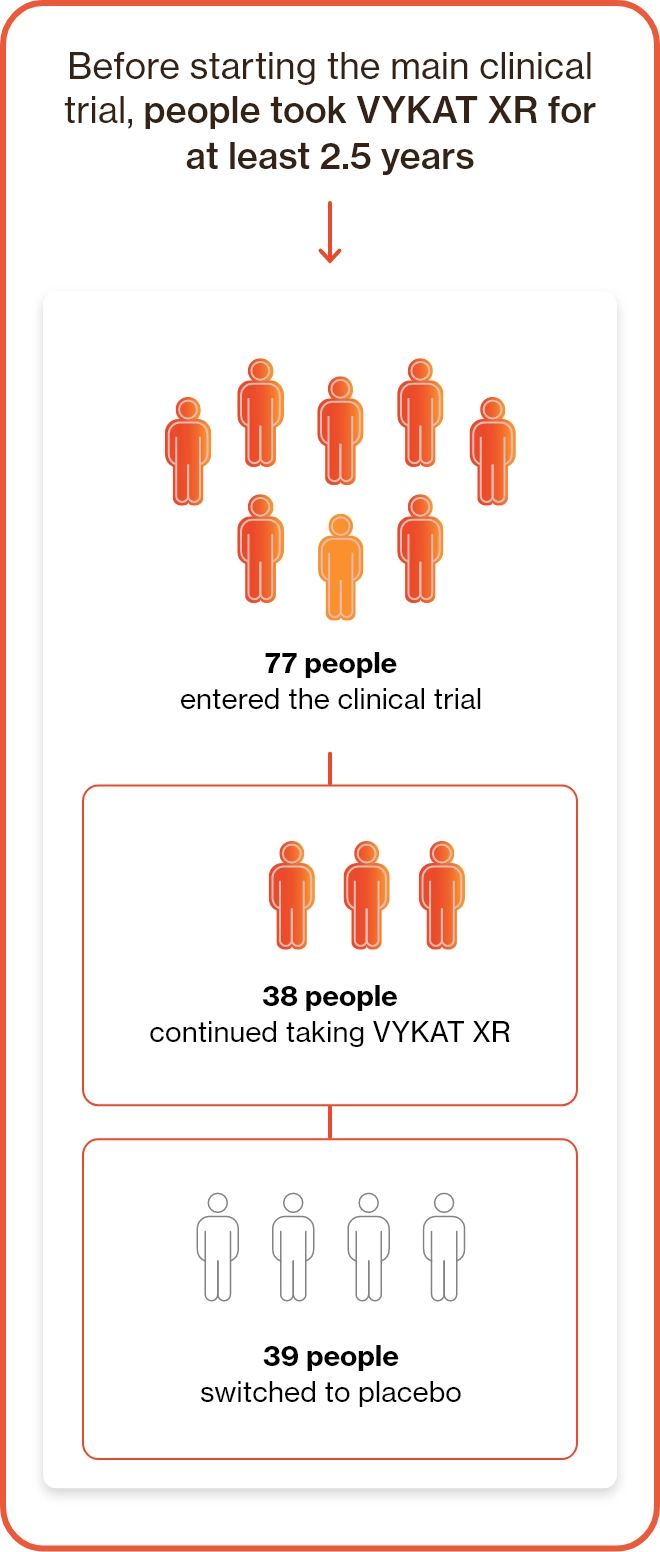
Hyperphagia was measured by the Hyperphagia Questionnaire for Clinical Trials (HQ-CT), which asked caregivers about the individual’s behavior seen in the previous 2 weeks
The lower the score, the less hyperphagia.

What the hyperphagia questionnaire asked about:
- Bargaining and manipulating for food or repeatedly asking after being told “no”
- Mood when denied food or asked to stop talking about food
- Sneaking food, stealing food, foraging through trash for food, or waking up at night to look for food
- Daily activities being interrupted by food-related behaviors and time spent asking or talking about food
HQ-CT owned by FPWR. Contact information and permission to use: Foundation for Prader‑Willi Research, www.fpwr.org
What’s the most important information I should know about VYKAT XR?

High blood sugar levels (hyperglycemia) is common during treatment with VYKAT XR and can also be severe.
Your doctor will check your blood sugar levels and HbA1c before and throughout treatment. If you get hyperglycemia during treatment with VYKAT XR, your doctor may give you medicines or adjust your medicines for hyperglycemia. Your doctor may also change your dose, temporarily stop, or permanently stop VYKAT XR.
Tell your doctor if you get any of the following signs and symptoms:
- Hyperglycemia: feel very thirsty, need to urinate more often than usual, have higher amounts of urine than usual, feel more hungry than usual, or weight loss
- Diabetic ketoacidosis: nausea, vomiting, stomach-area (abdominal) pain, feel weak or very tired or trouble breathing

Swelling in the body from too much fluid (fluid overload) is common during treatment with VYKAT XR and can also be severe.
Your doctor may decrease your dose or temporarily stop VYKAT XR if you get fluid overload. Tell your doctor if you have trouble breathing or get any other signs or symptoms of fluid overload such as swelling of your legs, ankles, or feet, or unusual swelling anywhere in your body.
Call your doctor for medical advice about side effects. You may report side effects to Soleno Therapeutics, Inc. at 1-833-765-3661 or to the FDA at 1-800-FDA-1088 or www.fda.gov/medwatch.
What are the possible side effects of VYKAT XR?
More than 5% of people taking VYKAT XR and 2% of people taking placebo in the clinical trial from study 1 experienced the side effects below
| Side effects | VYKAT XR 84 participants N (%) | Placebo 42 participants N (%) |
|---|---|---|
| Increased hair growth all over the body | 36% | 14% |
| Swelling in the body* | 27% | 12% |
| High blood sugar levels† | 17% | 5% |
| Rash‡ | 12% | 2% |
| Fever | 6% | 0% |
| Joint pain | 5% | 2% |
| Flu | 5% | 2% |
| Cold | 5% | 2% |
*Swelling/too much fluid can include the following areas of the body: hands, legs, feet, face, eyes, and lungs.
†Increased blood sugar levels include type 2 diabetes.
‡Rash includes those caused by direct contact with a substance or allergic reaction to one, those triggered by infections or autoimmune disorders, side effects from prescribed medicine, or reactions to certain foods.

How to get started on VYKAT XR

Check out helpful educational resources
 */
*/

